Kayci Jones
3.1 Module Summary
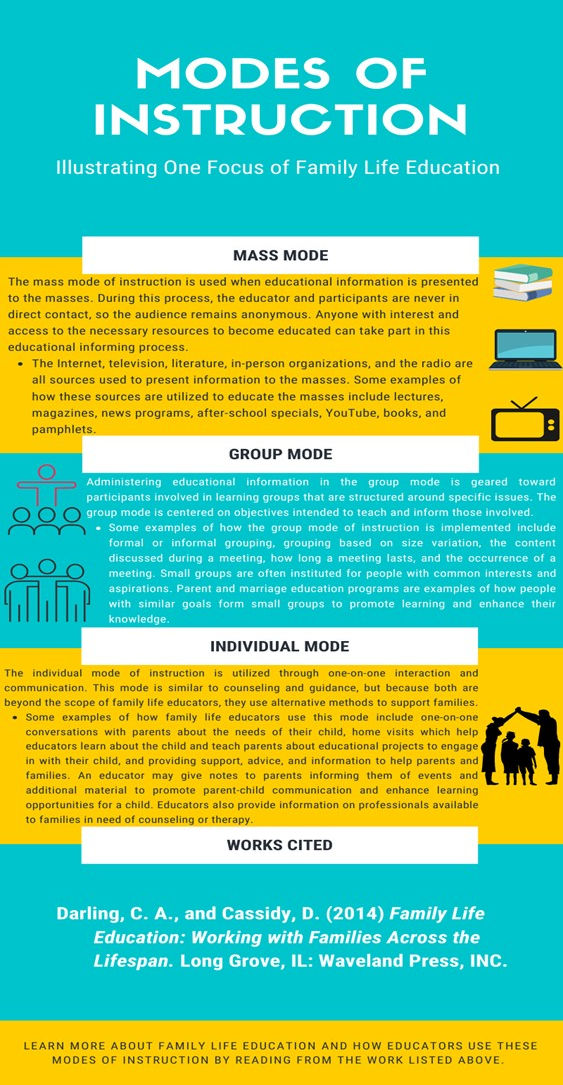
In this module I learned about the modes of instruction family life educators use to assist families. These modes include the mass mode in which educators speak to the masses through media sources such as television or the Internet, but also through in-person organizations and literature, the group mode which involves small groups of people with similar situations and goals, and the individual mode which entails an educator to engage in one-on-one communication with others in order to help them. I also learned about the importance of receiving feedback. Teachers provide formative feedback to students, while constructive feedback from peers is just as productive. I think the most important thing I learned in this module was the six different levels of the learning process. Knowledge involves recalling information, comprehension entails explaining information, application is about using information, analysis involves separating information, synthesis involves combining information, and evaluation entails making an assessment about the information. I think it is important to be informed on this particular matter because it demonstrates how an educator can ensure that the students, parents, or families they are teaching procure an exemplary learning experience. As a future family life educator, having knowledge on this subject will be beneficial in how I educate others.
Reference:
Darling, C. A., and Cassidy, D. (2014). Family Life Education: Working with Families Across
the Lifespan. Long Grove, IL: Waveland Press, INC.
3.6 Modes of Instruction
3.7 Acting it Out
LAB Challenge 3


