Kayci Jones
5.1 Module Summary
In this module, I learned about how much the socioeconomic status of a family can affect adolescent development. Socioeconomic status (SES) is determined by one's education, income, and/or occupational status. Having a higher level of education makes a person more likely to obtain a job with more prestige and in turn have a higher income. One study found that children from high SES families were able to engage in sustained attention, limit distractions, and have self-control over their impulses more than children growing up in low SES families. Material resources, social connections, parents who are educated about adolescent development and are able to encourage their children to learn skills are a few factors that children from low SES families may lack. SES can also affect how adolescents are treated by their peers. Inadequate social connections or materials like clothing may cause a child to be neglected or rejected by their peers. Children can become withdrawn, unsociable, and aggressive when they aren't liked or are ignored by their peers, which can influence how adolescents develop both mentally and physically. I also learned about the benefits positive experiences in youth development programs can have on children and adolescents. Participating in programs that involve extracurricular activities like sports and community service can help adolescents education wise and socially. Program participation can be linked to lower dropout rates and attainments of higher education levels following high school. Research has shown that adolescents who participate in youth development programs are able to take on social issues by learning to contribute to their family, community, and society and they are less likely to engage in risky behavior such as substance abuse or violence. Patterns of risk-resilience and the affect they have on adolescent development was also a topic I learned about in this module. Patterns of risk-resilience show the varying ways in which one develops. Whether the developments of an adolescent be good or bad, the interactions of their genes and the environment in which they are developing reveal patterns for risk or resilience factors that often differ from one adolescent to another. An individual's genetic tendencies interact with factors in their environment such as their culture, race, economic background, or educational level that influences their pattern of development.
Reference:
Anthis, K. (2021). Child and adolescent Development: A Social Justice Approach. San Diego, CA: Cognella
Academic Publishing.
5.3 Chart It Out

I have found that a person's income is one of the main determinants of career prestige, but their education level and job duties factor in as well. Teachers make much less than surgeons, who are thought to be some of the most prestigious, yet people categorize teachers as prestigious as well because they received a higher education and are commended by society for dealing with the difficulties of teaching students. Waitressing at a high-end restaurant and working for a chef who is considered prestigious or well respected in their community can increase annual wages and tips that a waitress receives. A career as a cashier is not really thought to be prestigious because in most cases no higher schooling was obtained and they do not receive an increased income from tips like a waitress receives.
5.5 Tell Me More Brochure


5.7 "The real cost" for youth programs
If I were running a youth program, I would be able to use resources such as cessation programs, videos, and infographics relating to smoking and the use of e-cigarettes as a way to support participating youth who are currently smoking or at risk. I would be able to use cessation programs to help adolescents or teens who are interested in quitting smoking. One program in particular has had positive results in helping teens stop smoking and using e-cigarettes. N-O-T: Not On Tobacco is a cessation program that has been proven to help teens stop smoking and vaping. This program is taught by a trained professional and in sessions geared toward different aspects to support teens in their journey of quitting. Some of the sessions involve teaching teens why they should quit smoking or vaping, helping them figure out why they started in the first place, the benefits of quitting, and how to deal with the struggles they will face while trying to quit. I would contact an educator that is qualified to teach sessions and have them teach sessions to some of the youth in my program interested in quitting smoking or vaping. I could even have a member of our staff become certified to lead these cessation programs. There is also educational and health materials to obtain from their website that would be beneficial to youth members. For more information on N-O-T: Not On Tobacco cessation program and other similar programs please click on the link below:
https://www.lung.org/quit-smoking/helping-teens-quit/not-on-tobacco
Another helpful resource to help teens stop smoking or vaping would videos. Videos about the harmful consequences of smoking and vaping would be useful for the youth in my program. Showing videos does not always ensure that the viewers will take away from it, but it does ensure that knowledge on an important subject is shared with them. I would compile some videos about the harmful affects of smoking and vaping, the harmful effects of others due to secondhand smoke, or the benefits of stopping the use of cigarettes and e-cigarettes, and organize a video presentation for the youth in my program to join. It would be an activity for anyone in my program to participate in. It would be geared towards those who are already smoking or vaping, but also be informative for youth who are at risk or considering smoking and vaping. Smoking has effects on one's health such as developing cancer or heart disease, along with consequences like losing teeth or premature aging of the skin. Showing videos of these consequences will hopefully encourage adolescents and teens in my youth program to either stop smoking and vaping or encourage them to never start. Here are a few helpful videos I found that could help the youth in my program.
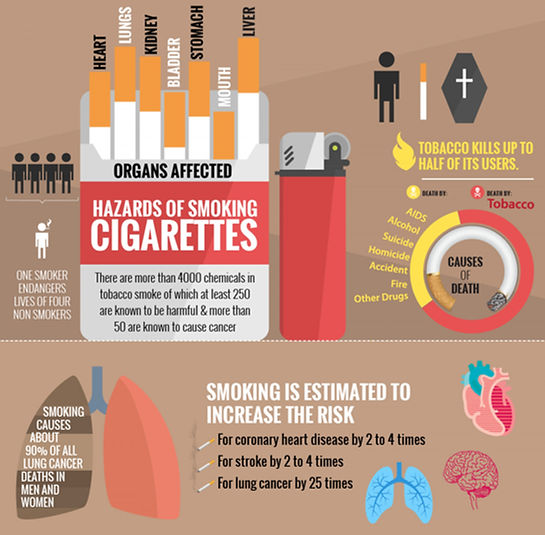
A third resource that I would use to benefit youth involved in my program would be infographics. Infographics are a fun way to inform youth about important issues like the harmful affects of smoking cigarettes and the use of e-cigarettes. Infographics showcase important information without having to read a lot, which is ideal for youth since they are hardly ever interested in reading. They also include graphic images or charts to relay information in a more exciting way aside from the use of words alone so that the infographic will catch the reader's eye. I would either find some interesting infographics on the topic of cigarette and e-cigarette use online or even create some of my own with information on the harmful effects of smoking and vaping to share with adolescents and teens in my youth program. Sharing this information in the form of infographics will help the youth in my program learn about consequences of smoking cigarettes and e-cigarette use and the benefits of stopping in a creative way that will ideally encourage them to stop smoking or vaping and for those who don't already to never start. Below is an example of an infographic I found and would give to the youth involved in my program.
SUCCESS POINTS: Words of Wisdom
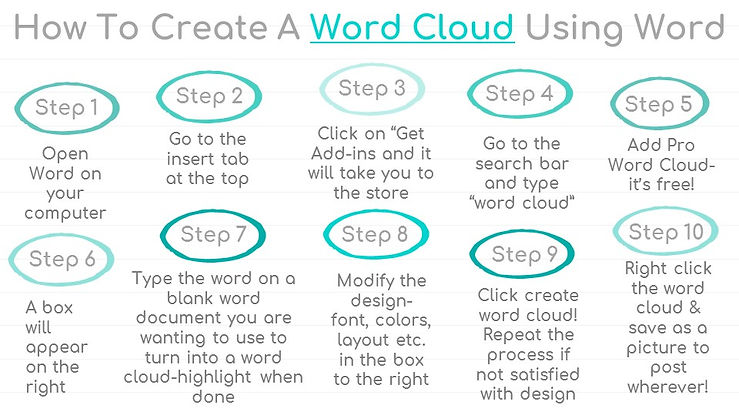
The words of wisdom I have to offer are on the topic of how to create a word cloud using Microsoft Word. I had to learn how to do this for one of my learning log assignments and wanted to share how I did it! I made a step-by-step infographic on how to do so and have posted it below. I hope this helps students in the future!