Kayci Jones
Service-Learning Project
SL 1: What Is Service-Learning?
Service-Learning can be described as the process of combining your learning to the needs within your community. There are five steps created to utilize service-learning in the most efficient way. The first step in service-learning is to investigate by discovering the talents we have to help others and make a difference in the world. The next step is preparation which is done by creating a plan of action on how to address the needs of a community. Step three is to take action. We can do so by committing our time to making a difference. There are four ways we can take action. Direct service involves working directly with or for people, animals, or the community. Indirect service involves working for a cause without seeing who it helps. Advocacy is a way to lend your voice to a cause or movement that helps others. Research entails gathering information about an issue to inform others to act. The fourth step is to reflect in which we think about, discuss, and learn from our actions after each service. The final step is demonstration in which we share our accomplishments. Service-learning differs from regular service projects because it involves following these steps to ensure a specific need is targeted and met in a community, whereas regular service projects are not always as detailed. Service-learning can promote problem solving skills, help students think on their feet, and help them gain the ability to work as a team and in diverse settings. In one study 100% of students involved in service-learning graduated from high school. In another study service involvement strongly influenced students decision to follow a career in a service field. Some students expressed how information learned in books came to life through service-learning. Service-learning is a way to assist students in becoming influential members of the community teachers are preparing them for.
References:
Learning to Give (2017). Stages of Service Learning. https://youtu.be/kFd-yiAfrmE
Astin, A. W., Vogelgesang, L. J., Ikeda, E. K., and Yee, J. A. (2000). How Service Learning Affects Students.
https://digitalcommons.unomaha.edu/slcehighered/144
JGP Productions LLC (2013). Making the Connection: The Service Learning Revolution.
SL2: Who Do I Ask?
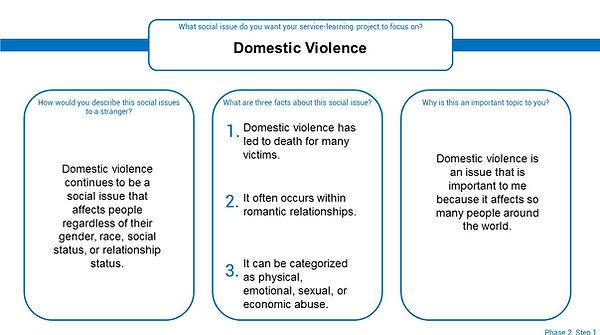



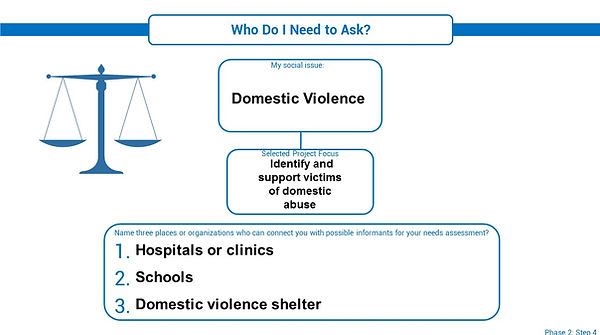
Teachers
Teachers often



SL3: What Do You Need?
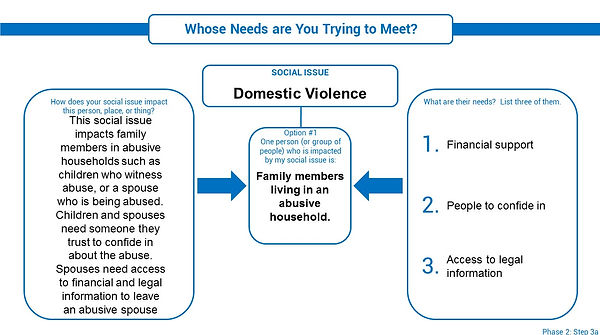
For my needs assessment I created a survey for teachers to complete in order for me to find out what they need to support students who are victims or suspected victims of domestic violence. I spoke with multiple teachers and a student teacher who took the survey and listed the results I found to be the most sufficient in the space below.
As a teacher, how can you support students who are victims of domestic violence?
Q1
Have you ever had a student you suspected was a victim of domestic abuse?
Yes on multiple occasions.
Q2
What did you do for that student?
I notified the principle and counselor of my suspicions. Myself and some other teachers who also taught the students went out and bought them some food, clothing, blankets, hygiene items, and toys depending on each student's needs.
Q3
What do you need to support students who are victims of domestic violence?
I believe we need more counselors to build rapport with students suspected of abuse in the hopes that they will open up and admit to being abused. Often times our hands are tied without proper evidence of abuse, so having more counselors for students to open up to would help.
Q4
What else do you need to support students you suspect are being abused?
I think students would also benefit from literature such as pamphlets or brochures that depict abuse and emphasize that it is wrong in a way that a young child could comprehend. This would help children understand that what is happening to them is not okay and hopefully encourage them to open up about it to an adult they trust.
One of the needs I learned of from this needs assessment is for literature such pamphlets, brochures, or even infographics that I could supply to a teacher who needs them to inform her students about domestic abuse in ways that help a child understand that abuse is wrong and encourage them to speak up about it to someone they trust.
SL4: What is Your Focus?
Upon digging deeper into the social issue of domestic violence, I have created the infographic below to better inform others on the topic of domestic violence.

SL5: What Could it Look Like?

SL6: What Will It Look Like?
I have decided to address the need in my community by creating brochures about the topic of domestic violence for teachers to distribute to their students. I have designed an appealing and explanatory brochure with young children in mind. I believe this is the best route to meet the teacher's need in order for her to support students who are victims of domestic violence. I have planned a project and named it The Helping Handout because through this project I will be providing teachers with a handout (brochure) intended to help their students who suffer from domestic abuse. I have created a logic model and timeline/checklist to better execute and ensure a successful project and posted them below.

PRE-PROJECT CHECKLIST
-
Have you given yourself enough time needed to complete the project?
-
Do you have access to resources (power point/printer) needed to complete the project?
-
Do you have enough information on the project topic?
-
Have you met with the person/people who assisted you in developing the project?
-
Do you have a plan for getting the product of your project (brochure) to them?
-
Have you created enough brochures for the anticipated number of students who will receive them?
DAY OF PROJECT TIMELINE
1-3 Hours Before the Project:
-
Make sure the brochures are complete and I am satisfied the finished product.
-
Collect & organize the brochures to be dropped off to the teacher I am working with.
-
Confirm the time & location discussed to deliver the brochures.
-
Make sure I have a way to deliver the brochures.
Throughout the Project:
-
Be able to explain the reasoning behind this project to others.
-
Thank the teacher I am working with for the opportunity to meet a need.
-
Take Pictures.
Before the End of the Project:
-
Be sure to ask the teacher to complete an evaluation to determine whether the project was an overall success.
-
Reflect on the experience I gained from the project.
Before You Leave the Project Site:
-
Have one last debriefing with the teacher who led me to create this project.
Immediately After the Project:
-
Determine if the needs were met and if not discuss how to meet them another way.
-
Arrange a follow-up meeting with the teacher I worked with for this project.
-
Identify ways I could improve the project.
DAY OF PROJECT CHECKLIST
-
Verify that materials/supplies are ready to be delivered.
-
Prepare a brief statement of project overview and the intended impact.
-
Be prepared to answer any questions about the project.
-
Take pictures if possible.
-
Reflect on and evaluate the work done to complete this project.
-
Thank the teacher I worked with to make this project possible!
PROJECT DAY AGENDA
Time: Activity:
10:00 am Sort through the brochures I created and choose the best
Arrange the brochures neatly in preparation for delivery
11:00 am Confirm the time and location site discussed for delivery
11:30 am Gather my brochures and place them in box
Head out to deliver my brochures in time
12:00 pm Arrive at location to deliver my brochures
Discuss the project overview and intended impact
12:30 pm Arrange a follow-up discussion of the project’s impact
Take picture distributing the brochures
Thank teacher I worked with for helping me devise and organize this project
SL7: Am I Ready?
SL8: How Is It Going?
PRESS RELEASE
CONTACT INFORMATION:
Kayci Jones
McNeese State University
337.517.5406
FOR IMMEDICATE RELEASE
December 6, 2020
THE HELPING HANDOUT GIVEAWAY
The Helping Handout is a brochure that will help young children learn about domestic violence and teach them to recognize the signs, speak out about their experience, and receive help.
Lake Charles, LA-- Many children are victims of domestic violence and endure physical, emotional, sexual, and mental abuse along with neglect. So many do not know what is happening to them them, so they never talk to anyone about their situation and ask for help.
I have partnered with a teacher in the area to create brochures focused on domestic violence that explains it so a young child can comprehend. I will distributing them to the teacher and she will give them to her students accordingly.
"In a world where domestic violence against children is often hard to prove and goes ignored or unnoticed, I am happy to say I have created The Helping Handout to educate children about domestic violence and keep them from falling prey to the blind eye of society." said Kayci Jones about the service-learning project she has created.
If you know of a child who may be in an abusive situation and would benefit from the knowledge of domestic violence, please contact me @ msu-kjones19@mcneese.edu to discuss The Helping Handout Giveaway and how you can support someone you know.
McNeese State University's Family Science Program has equipped me with the tools necessary to execute a service-learning project like The Helping Handout Giveaway. The program prepares it's students for real-world experiences and a successful career in strengthening families through service, education, and guidance.
###
PHOTO OPPS
My photo opp plan will include the teacher I have been working to complete the project with. She is going to have her nephew who is 9 years old read the brochure for us and see what his opinion is. I will have a friend who is helping me deliver the brochures take our photo and I will have a picture of myself, the teacher I partnered with, and her nephew be in the photo holding up each a side of the brochure and I will submit it to the local newspaper.
![IMG_E4630[1].JPG](https://static.wixstatic.com/media/1c6b9c_5c137a285e7542e98fdbbf5f5dfd0367~mv2.jpg/v1/crop/x_0,y_404,w_3023,h_2673/fill/w_455,h_401,al_c,q_80,usm_0.66_1.00_0.01,enc_avif,quality_auto/IMG_E4630%5B1%5D_JPG.jpg)
![IMG_4620[1].JPG](https://static.wixstatic.com/media/1c6b9c_6bf874328dd646c0a448f13139d1b0a5~mv2.jpg/v1/crop/x_0,y_186,w_3024,h_3352/fill/w_426,h_475,al_c,q_80,usm_0.66_1.00_0.01,enc_avif,quality_auto/IMG_4620%5B1%5D_JPG.jpg)
![IMG_4603[1].JPG](https://static.wixstatic.com/media/1c6b9c_55048d0bed854976b73a202feec22b59~mv2.jpg/v1/crop/x_0,y_304,w_3024,h_3195/fill/w_484,h_515,al_c,q_80,usm_0.66_1.00_0.01,enc_avif,quality_auto/IMG_4603%5B1%5D_JPG.jpg)
![IMG_E4645[1].JPG](https://static.wixstatic.com/media/1c6b9c_a797a640cfe8413db3349ada0174a15e~mv2.jpg/v1/crop/x_0,y_8,w_2448,h_1840/fill/w_631,h_475,al_c,q_80,usm_0.66_1.00_0.01,enc_avif,quality_auto/IMG_E4645%5B1%5D_JPG.jpg)
![IMG_4602[1].JPG](https://static.wixstatic.com/media/1c6b9c_110592f0efc14d8eb9fe827c58410eb0~mv2.jpg/v1/crop/x_615,y_5,w_1814,h_3604/fill/w_360,h_715,al_c,q_80,usm_0.66_1.00_0.01,enc_avif,quality_auto/IMG_4602%5B1%5D_JPG.jpg)
SOCIAL MEDIA
"This semester I conducted a Service-Learning Project for my Family Life Education course and wanted to share my project. I conducted a needs assessment and determined that teachers needed literature material that explains what domestic violence is. So many of their students don't speak up about the abuse and the teachers need books or brochures that will help them learn about domestic violence and open the door for students to talk about their experience to their teacher. I created a brochure that defines domestic violence using simple terms so that young children can comprehend. I also gave examples of forms of abuse such as physical, emotional, sexual, and neglect. I created a checklist for students to determine whether or not they have ever experienced domestic violence. I also encourage them to talk about their situation with someone they trust. I really enjoyed conducting this project and hope the needs of the teachers are met and they are able to better support students of domestic violence because I met the need."
![IMG_E4644[1].JPG](https://static.wixstatic.com/media/1c6b9c_ec7a1a15f6b64323af94cfca76f6b0da~mv2.jpg/v1/fill/w_525,h_391,al_c,q_80,usm_0.66_1.00_0.01,enc_avif,quality_auto/IMG_E4644%5B1%5D_JPG.jpg)
SL 9: How Did It Go?
I completed an evaluation report for my project The Helping Handout by asking a child to read my brochure then answer some questions about it. He is part of the intended age group of students who will be receiving the brochure, so his opinion was helpful in gauging whether other students will learn something from the brochure. I used a chart format to display the results of his evaluation of my project. I also asked the teacher I worked with to create this project to help me decide the importance of certain aspects of the brochure by using percentages for each important aspect that make up the whole by using a pie chart. Both evaluation results are displayed in my infographic below.

SL10: What is Different Now?
NARRATIVE REFLECTION:
1. What was your favorite part of the project?
-My favorite part of this project was actually making the brochures. I enjoyed creating something that will hopefully make a difference in the lives of young children who are victims of domestic violence or know someone who is a victim.
2. How did working on your SL project change your perspective?
-Working on this project changed my perspective in the way I look at what others need. So many projects are conducted on basis of what the project planner thinks someone needs which is not always what someone actually needs. I enjoyed this SL project because I was able to go out and meet a specific need of a teacher I spoke with. My perspective on what others need has been altered in a good way, and I now have a better understanding of how to consider what people need, ask what those needs are, and meet them.
3. What was the most challenging part of the project?
-The most challenging part of this project was defining and giving examples of sexual abuse. When it comes to sexual abuse involving children I have to tread lightly because if a child were to accuse someone of that form of abuse, it is serious accusation. I wanted to get the point across simply without going into to much detail and I was satisfied when some of the people who read my brochure said that I did well on that aspect of domestic abuse.
4. If you did this project again, what would you do differently?
-The one thing I would do differently would be using more pictures in my brochure. After evaluating with my teacher, we decided that the pictures were the most affective aspect of the brochure and is the easiest way younger children will understand the definition of domestic violence. I assumed that the examples of abuse I used on the checklist flap would be the most affective so I focused on that aspect the most, next time I would focus on the photographs instead.
5. If you did this project again, what would you do the same?
-If I were to do this project again, I wouldn't stray from using teachers to help with this specific social issue. Teachers are the people who see students everyday and have one of the greatest opportunities to help those who are victims of domestic abuse. I would partner with teachers again in the future to find out what they need to better support their students.
CELEBRATE YOUR ACCOMPLISHMENT:
I wrote a thank you note to the teacher I partnered with to create and execute this project. I was very pleased with the work we did together and am very thankful that she was able to work with me and ensure the best outcome for my project The Helping Handout.
![IMG_4648[1].JPG](https://static.wixstatic.com/media/1c6b9c_c92adbbf4e8a49759d412c65525447c9~mv2.jpg/v1/crop/x_0,y_471,w_3024,h_3271/fill/w_386,h_415,al_c,q_80,usm_0.66_1.00_0.01,enc_avif,quality_auto/IMG_4648%5B1%5D_JPG.jpg)
![IMG_4649[1].JPG](https://static.wixstatic.com/media/1c6b9c_4687fdff8df44e98b97d4cc6a6fa83d7~mv2.jpg/v1/crop/x_7,y_285,w_3017,h_2887/fill/w_435,h_415,al_c,q_80,usm_0.66_1.00_0.01,enc_avif,quality_auto/IMG_4649%5B1%5D_JPG.jpg)