Kayci Jones
6.1 Module Summary
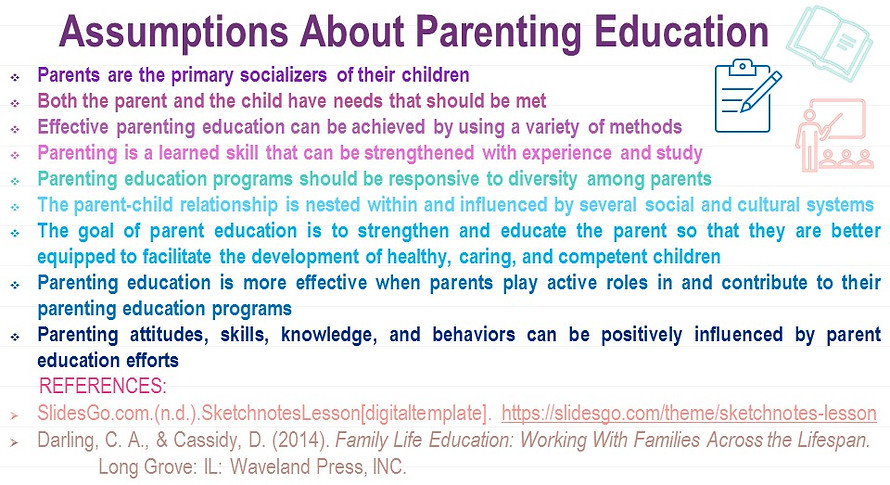
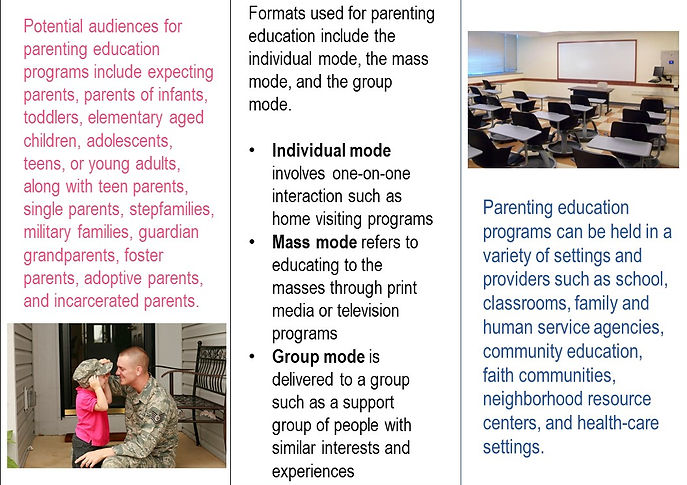
In this module I learned about the assumptions of parenting education and how to access resources on the subject. Some of the assumptions of parenting education include: parenting is a learned skill that can be strengthened by experience or study, when parents actively participate and contribute to their parenting education programs their parenting is more effective, through a variety of methods effective parenting education can be accomplished, and the goal of parenting education is to strengthen and educate the parent to ensure that they are equipped to facilitate the development of healthy, caring, and competent children. Informational resources available to parents on parenting or parenting education include books, websites, in-person or online classes and programs, as well as mobile apps. I also learned that parents have a tremendous influence on their children throughout the lifespan. Parents play a role in the cognitive, emotional, physical, and social development of their child. Just as children develop over time, so do parents. The stages of parental development include the consideration of parenthood, the transition into parenthood, and stage theories of parenthood and the family life cycle. Lasting and meaningful outcomes on a child's development is often dependent on the cognitive and emotional development of parents. I also learned about the factors that contribute to successful parenting education from this week's readings. Those factors include format in which parenting education is instructed using the individual mode, group mode, or the mass mode; prevention approaches including primary prevention in which people are educated prior to a negative event, secondary prevention involves education following the occurrence of problems, conflicts, or risks to halt or slow the progress of such events, and tertiary prevention which centers helping people deal with complicated, long-term problems to prevent further harm; audience in which the parents of infants, toddlers, adolescents, teens, or adults are educated to in a way that is geared toward their specific stage in parenting; and setting which involves the location of a parenting program offered by a variety of providers such as schools, family and human service agencies, neighborhood resource centers, faith-based communities, health-care settings, and community education. The format, prevention approaches, audience, and the setting of how and where parenting education programs are conducted are the factors that determine the quality and success of a parenting education program.
Reference:
Darling, C. A., and Cassidy, D. (2014). Family Life Education: Working With Families Across
the Lifespan. Long Grove, IL: Waveland Press, INC.
6.2 Online Resources For Parents
6.3 Assumptions of Parenting Education Infographic
6.6 Parenting Information Brochure

LAB Challenge 6
PREMIUM POINTS: Words of Wisdom

For my words of wisdom assignment, I have made an infographic about the website Canva. This is the site I used to make a lot of my infographics this semester, so I included some of the perks about the website and how easy it is to use! I think it is a really helpful tool for future students.